≥99.0%
€75
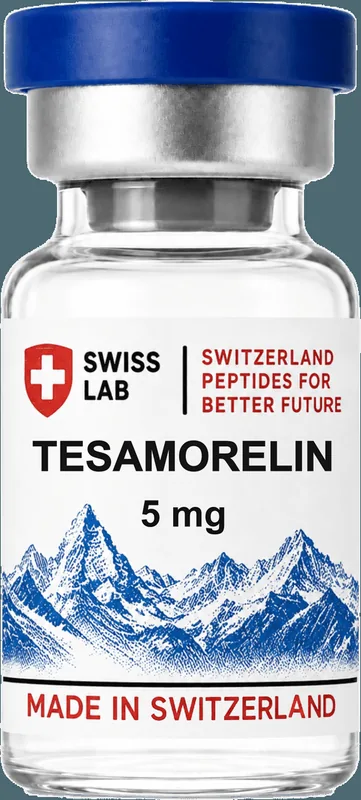
Tesamorelin is a full-length 44-amino acid human GHRH analogue stabilized at its N-terminus with a trans-3-hexenoic acid group to prevent DPP-4 cleavage while preserving native pituitary GHRH receptor kinetics.
Tesamorelin is a full-length 44-amino acid human GHRH analogue stabilized at its N-terminus with a trans-3-hexenoic acid group to prevent DPP-4 cleavage while preserving native pituitary GHRH receptor kinetics.
Analytical release verification for current Tesamorelin (5 mg) inventory
| Batch Lot # | Release Date | Analytical Method | Purity Spec | Endotoxin (LAL) | Moisture |
|---|---|---|---|---|---|
| SL-2026-162 | 2026-10-28 | RP-HPLC (C18, 214nm) + ESI-MS | ≥99.0% (Single Peak) | <0.5 EU/mg | <2.8% (Karl Fischer) |
Sterile 0.9% Bacteriostatic Water (1.0–2.0 mL)
Store lyophilized at -20°C; refrigerate solution at 2°C–8°C for up to 21 days.
Reconstituting the full 5 mg vial of Tesamorelin (MW 5135.77 g/mol) in 2.0 mL of diluent produces a 2.50 mg/mL stock solution — equivalent to approximately 0.49 mM (487 µM) gross molarity before Net Peptide Content (NPC) adjustment.
Tesamorelin (CAS 218949-48-5, formula C221H366N72O67S) is supplied as Acetate lyophilized salt. Because counterions and residual bound water contribute to gross lyophilized weight, quantitative receptor-binding assays should apply batch Net Peptide Content (NPC) or active-ion correction rather than gross cake weight alone.
Lot SL-2026-162 undergoes RP-HPLC (C18, 214nm) + ESI-MS confirming ≥99.0% (Single Peak) and identity against 5135.77 g/mol. In preclinical literature, Tesamorelin targets Pituitary GHRH Receptor (full-length stabilized GHRH 1-44 analogue) (Falutz J. et al., N Engl J Med (2007) — Metabolic effects of trans-3-hexenoyl GHRH(1-44) analogue Tesamorelin (PMID: 18057338)).
Peer-reviewed mechanism summaries and analytical protocols
A deep dive into somatotropic axis stimulation. Comparing GHRH receptor binding, DAC modification kinetics, ghrelin/GHS-R1a agonism, and pulsatile growth hormone secretion.
A comparative map of the HPG axis: GnRH receptor agonism (Gonadorelin), LH receptor mimetics (HCG), combined FSH/LH activity (HMG), and upstream GPR54 activation (Kisspeptin-10).
A deep analysis of authentic 191-amino acid Somatropin vs 192-amino acid Somatrem. Size-exclusion chromatography (SEC), deamidation artifacts, and mass confirmation.
0 items selected • Min. order €220
Your cart is empty
Browse our catalog of research peptides and reagents (minimum order €220).