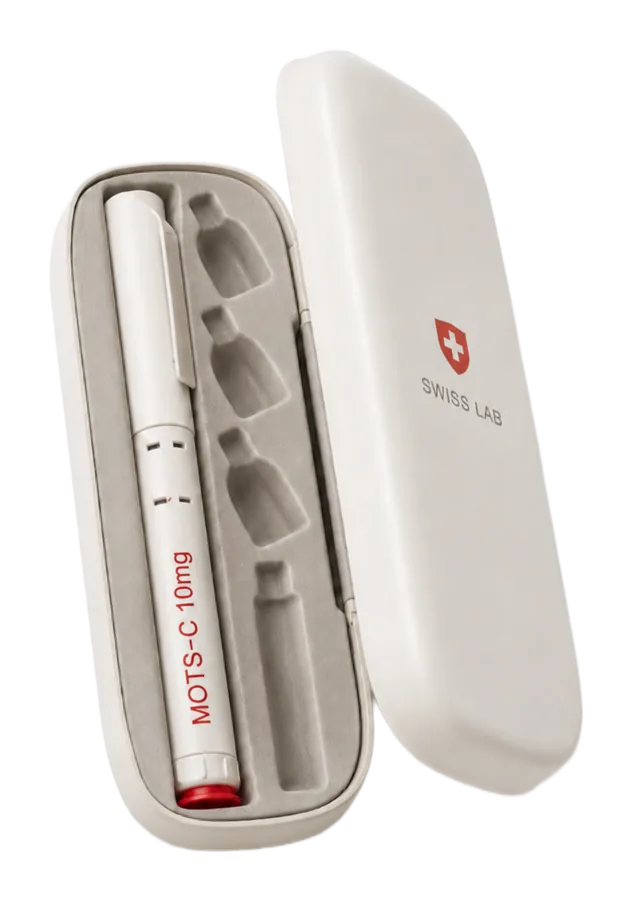
MOTS-c Calibrated Research Pen
Because MOTS-c contains an oxidation-sensitive N-terminal methionine residue (Met1), repeated vial punctures introduce atmospheric oxygen that converts active peptide into methionine sulfoxide (+16 Da). Our sealed, nitrogen-headspace 3 ml cartridge inside an anodized light-blocking pen chassis minimizes oxidative degradation during multi-day AMPK and metabolic bioenergetics assays.
Zero-Headspace Cartridge Engineering
Airless plunger displacement prevents atmospheric oxygen ingress after every micro-aliquot draw, preserving intact unoxidized Met1 MOTS-c significantly longer than multi-puncture septum vials.
10 µL Volumetric Calibration Math
10 mg MOTS-c (MW 2174.62 g/mol) in 3.0 mL provides a 3.33 mg/mL (1.53 mM) working stock. Every 10 µL click dispenses 33.3 µg (15.3 nmol) of MOTS-c with <2% volumetric CV.
Verify stock molarity in Lab Calculator →MOTS-c Calibrated Research Pen — Technical FAQ
Why does MOTS-c benefit uniquely from a sealed zero-headspace pen cartridge?
MOTS-c begins with an N-terminal methionine (Met-Arg-Trp-Gln-Glu-Met-Gly-Tyr-Ile-Phe-Tyr-Pro-Arg-Lys-Leu-Arg) susceptible to sulfoxide oxidation when air is injected into conventional multi-dose vials.
What molarity is inside the 10 mg / 3.0 mL MOTS-c cartridge?
At 3.33 mg/mL and MW 2174.62 g/mol, the cartridge concentration is ~1.53 mM (1,533 µM), delivering 33.3 µg per 10 µL dial click.