≥99.0%
€54
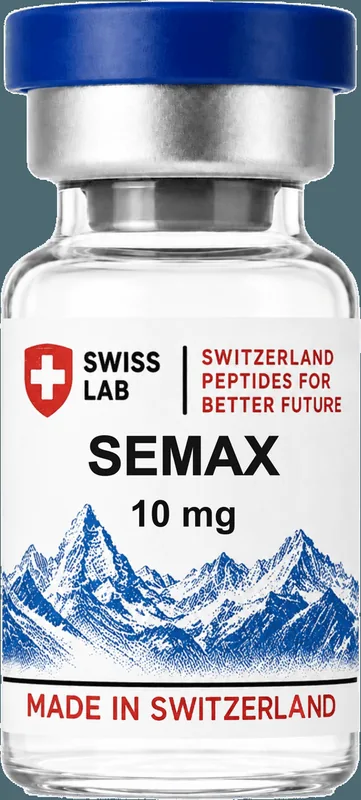
Semax is a synthetic heptapeptide combining the ACTH(4–7) core with a protease-resistant Pro-Gly-Pro C-terminus, researched extensively for rapid hippocampal BDNF/TrkB upregulation without glucocorticoid hormonal activity.
Semax is a synthetic heptapeptide combining the ACTH(4–7) core with a protease-resistant Pro-Gly-Pro C-terminus, researched extensively for rapid hippocampal BDNF/TrkB upregulation without glucocorticoid hormonal activity.
Analytical release verification for current Semax (5 mg) inventory
| Batch Lot # | Release Date | Analytical Method | Purity Spec | Endotoxin (LAL) | Moisture |
|---|---|---|---|---|---|
| SL-2026-155 | 2026-10-28 | RP-HPLC (C18, 214nm) + ESI-MS | ≥99.0% (Single Peak) | <0.5 EU/mg | <2.8% (Karl Fischer) |
Sterile 0.9% Bacteriostatic Water or sterile PBS (pH 7.4)
Store lyophilized at -20°C under nitrogen (protect Met1 from oxidation); refrigerate solution at 2°C–8°C.
Reconstituting the full 5 mg vial of Semax (MW 813.92 g/mol) in 2.0 mL of diluent produces a 2.50 mg/mL stock solution — equivalent to approximately 3.07 mM (3,072 µM) gross molarity before Net Peptide Content (NPC) adjustment.
Semax (CAS 80714-61-0, formula C37H51N9O10S) is supplied as Acetate lyophilized salt. Because counterions and residual bound water contribute to gross lyophilized weight, quantitative receptor-binding assays should apply batch Net Peptide Content (NPC) or active-ion correction rather than gross cake weight alone.
Lot SL-2026-155 undergoes RP-HPLC (C18, 214nm) + ESI-MS confirming ≥99.0% (Single Peak) and identity against 813.92 g/mol. In preclinical literature, Semax targets BDNF / TrkB & NGF neurotrophin expression, dopaminergic/serotonergic modulation (Dolotov O.V. et al., Brain Res (2006) — Semax rapidly increases hippocampal BDNF and trkB expression (PMID: 16996037)).
Peer-reviewed mechanism summaries and analytical protocols
A structural and pharmacological comparison of Russian-developed regulatory heptapeptides: Semax (ACTH 4-10 analogue) vs Selank (Tuftsin analogue). Molecular pathways and stability.
A practical guide for researchers. How to analyze HPLC chromatograms, verify retention time, interpret mass spec m/z peaks, evaluate counterion salt ratios, and spot fraudulent documents.
Standard Operating Procedure (SOP) for peptide reconstitution. Diluent selection (BAC water vs acetic acid), meniscus calculations, avoiding foaming, and cold storage parameters.
0 items selected • Min. order €220
Your cart is empty
Browse our catalog of research peptides and reagents (minimum order €220).