≥99.0%
€54
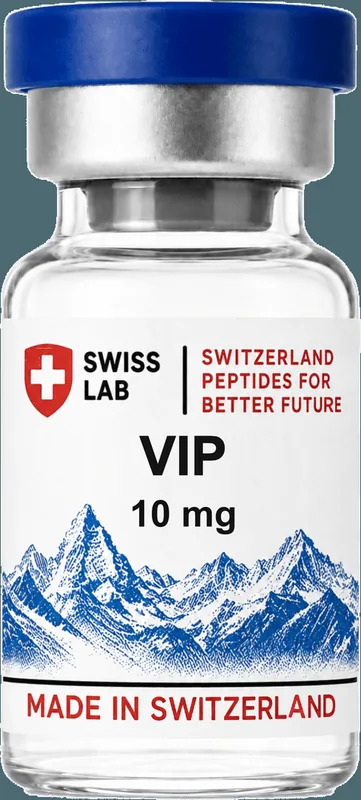
Vasoactive Intestinal Peptide (VIP) is a 28-amino acid neuroendocrine peptide acting on VPAC1 and VPAC2 Class B GPCRs, investigated in pulmonary vasodilation, circadian SCN synchronization, and microglial anti-inflammatory models.
Vasoactive Intestinal Peptide (VIP) is a 28-amino acid neuroendocrine peptide acting on VPAC1 and VPAC2 Class B GPCRs, investigated in pulmonary vasodilation, circadian SCN synchronization, and microglial anti-inflammatory models.
Analytical release verification for current VIP (5 mg) inventory
| Batch Lot # | Release Date | Analytical Method | Purity Spec | Endotoxin (LAL) | Moisture |
|---|---|---|---|---|---|
| SL-2026-166 | 2026-10-28 | RP-HPLC (C18, 214nm) + ESI-MS | ≥99.0% (Single Peak) | <0.5 EU/mg | <2.8% (Karl Fischer) |
Sterile 0.9% Bacteriostatic Water or neutral PBS (pH 7.0–7.4)
Store lyophilized at -20°C under nitrogen (protect Met17 from oxidation); refrigerate solution at 2°C–8°C.
Reconstituting the full 5 mg vial of VIP (MW 3325.80 g/mol) in 2.0 mL of diluent produces a 2.50 mg/mL stock solution — equivalent to approximately 0.75 mM (752 µM) gross molarity before Net Peptide Content (NPC) adjustment.
VIP (CAS 40077-57-4, formula C147H238N44O42S) is supplied as Acetate lyophilized salt. Because counterions and residual bound water contribute to gross lyophilized weight, quantitative receptor-binding assays should apply batch Net Peptide Content (NPC) or active-ion correction rather than gross cake weight alone.
Lot SL-2026-166 undergoes RP-HPLC (C18, 214nm) + ESI-MS confirming ≥99.0% (Single Peak) and identity against 3325.80 g/mol. In preclinical literature, VIP targets VPAC1 & VPAC2 (Class B GPCRs) — neuroimmune & circadian signaling (Delgado M. & Ganea D., Trends Mol Med (2013) — Vasoactive intestinal peptide neuroimmune regulation (PMID: 23415022)).
Peer-reviewed mechanism summaries and analytical protocols
A practical guide for researchers. How to analyze HPLC chromatograms, verify retention time, interpret mass spec m/z peaks, evaluate counterion salt ratios, and spot fraudulent documents.
Standard Operating Procedure (SOP) for peptide reconstitution. Diluent selection (BAC water vs acetic acid), meniscus calculations, avoiding foaming, and cold storage parameters.
Analytical protocols for preserving lyophilized and reconstituted peptides. Temperature zones (-80°C, -20°C, 4°C), freeze-thaw degradation, hygroscopicity, and photostability.
0 items selected • Min. order €220
Your cart is empty
Browse our catalog of research peptides and reagents (minimum order €220).