≥99.0%
€52
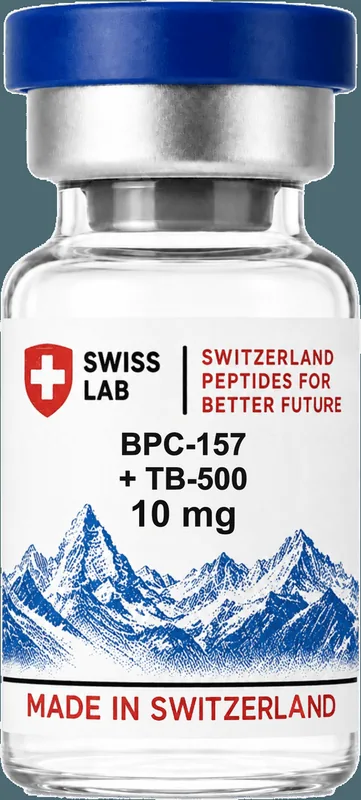
Standard-scale co-lyophilized research blend containing 5 mg BPC-157 and 5 mg TB-500 (10 mg total active peptide), formulated for bench-scale comparative tissue-repair and endothelial migration assays.
Standard-scale co-lyophilized research blend containing 5 mg BPC-157 and 5 mg TB-500 (10 mg total active peptide), formulated for bench-scale comparative tissue-repair and endothelial migration assays.
Analytical release verification for current BPC-157 5mg + TB-500 5mg (5mg + 5mg) inventory
| Batch Lot # | Release Date | Analytical Method | Purity Spec | Endotoxin (LAL) | Moisture |
|---|---|---|---|---|---|
| SL-2026-112 | 2026-10-28 | Gradient RP-HPLC (Multi-Peak Resolution) + ESI-MS | ≥99.0% (Resolved Constituent Peaks) | <0.5 EU/mg | <2.8% (Karl Fischer) |
Sterile 0.9% Bacteriostatic Water (2.0 mL); dissolve gently by rolling
Store lyophilized blend at -20°C; refrigerate reconstituted solution at 2°C–8°C for up to 28 days.
Because co-lyophilized blends contain multiple sequences with distinct retention times, Lot SL-2026-112 is evaluated via gradient RP-HPLC to resolve each constituent peak independently, paired with ESI-MS mass confirmation (1419.53 g/mol & 4963.50 g/mol).
Calculate each active constituent separately based on its labeled mass ratio (5mg + 5mg) divided by total diluent volume added. For example, adding 2.0 mL of sterile diluent yields proportional mg/mL concentrations for every component simultaneously.
Investigators study BPC-157 5mg + TB-500 5mg in Dual VEGFR2/NO angiogenesis & G-actin sequestration pathways models. Primary published literature context: Chang C.H. et al. (2011) & Philp D. et al., FASEB J (2004) — Fibroblast migration and dermal repair signaling. All lots are supplied strictly for in-vitro laboratory experimentation.
Peer-reviewed mechanism summaries and analytical protocols
A comparative analysis of Body Protection Compound-157 (pentadecapeptide) and Thymosin Beta-4 active fragment TB-500. Differences in VEGF signaling, actin sequestration, and combined laboratory models.
A biochemical review of Thymosin Beta-4 and its synthetic sequence TB-500. G-actin monomer sequestering, cell migration, down-regulation of inflammation, and HPLC analysis.
A practical guide for researchers. How to analyze HPLC chromatograms, verify retention time, interpret mass spec m/z peaks, evaluate counterion salt ratios, and spot fraudulent documents.
0 items selected • Min. order €220
Your cart is empty
Browse our catalog of research peptides and reagents (minimum order €220).