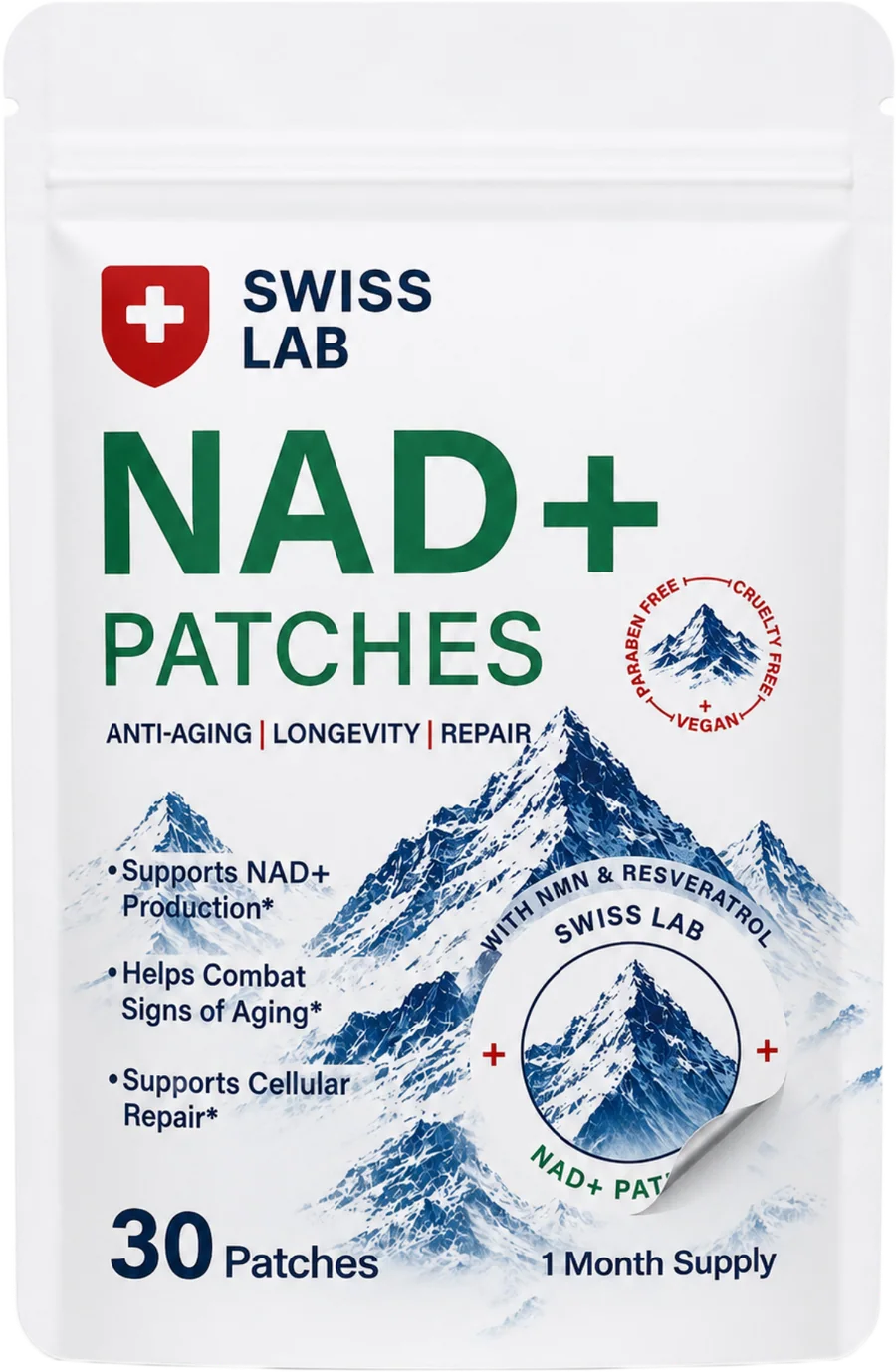
NAD+ Transdermal Research Patches
Engineered for Franz-diffusion cell and transdermal flux research, each NAD+ matrix patch incorporates stabilized β-NAD+ alongside polyphenolic and quinone cofactors (trans-Resveratrol, Ubiquinone/CoQ10, Pyrroloquinoline Quinone) in a controlled-release polymer adhesive layer designed to mitigate aqueous hydrolysis during sustained release modeling.
Matrix Active Constituents
- β-NAD+ (Nicotinamide Adenine Dinucleotide)
- trans-Resveratrol
- Coenzyme Q10 (Ubiquinone)
- PQQ (Pyrroloquinoline Quinone)
30 individually backed patches / foil pouch
8–12 hour controlled zero-order matrix flux
Pyridine dinucleotide & polyphenol cofactors
Franz vertical diffusion cell & synthetic membranes
Permeation & Diffusion Research Scope
Used in transdermal drug-delivery benchmarking to evaluate hydrophilic dinucleotide partitioning (β-NAD+, MW 663.43 Da) paired with lipophilic mitochondrial cofactors (CoQ10, trans-Resveratrol) across Strat-M or excised model membranes.
Matrix Architecture: Controlled-release hydrogel adhesive matrix (8–12 hour diffusion profile)
Laboratory Handling & Storage Protocol
Remove a single patch with sterile forceps immediately before mounting onto the donor chamber of a pre-equilibrated 32°C–37°C diffusion apparatus. Reseal the moisture-barrier foil pouch immediately to prevent hydrogel desiccation and photo-isomerization of trans-Resveratrol.
Storage Requirement: Store in sealed moisture-barrier foil pouch at 15°C–25°C away from direct UV light.
NAD+ Transdermal Research Patches — Technical Questions
Why is β-NAD+ formulated in a dry-sealed hydrogel matrix rather than unbuffered water?
Unbuffered aqueous NAD+ solutions hydrolyze rapidly at ambient temperature into nicotinamide and ADP-ribose. Embedding β-NAD+ inside a low-water-activity polymer matrix extends shelf stability prior to membrane hydration.
How is permeation flux quantified from receptor-chamber samples?
Receptor aliquots collected at 1, 2, 4, 8, and 12 hours are typically quantified via reverse-phase HPLC-UV (260 nm for NAD+, 306 nm for trans-Resveratrol) to compute steady-state flux (Jss) and lag time.