≥99.0%
€18
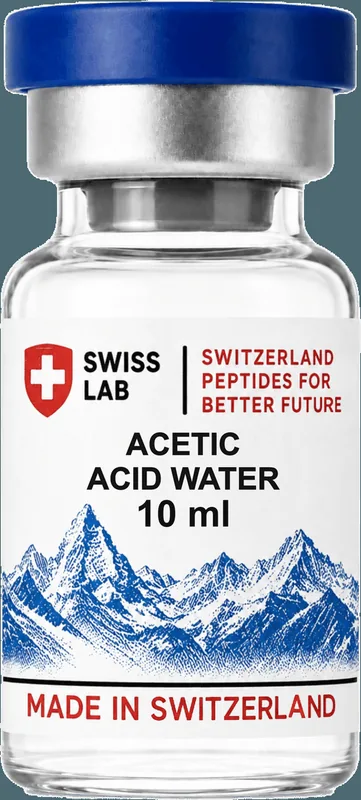
Sterile 0.6% (100 mM) aqueous acetic acid diluent in USP Type I borosilicate vials, specifically formulated for initial solubilization of hydrophobic or basic peptides such as IGF-1 LR3 and AOD-9604 that resist dissolution in neutral water.
Sterile 0.6% (100 mM) aqueous acetic acid diluent in USP Type I borosilicate vials, specifically formulated for initial solubilization of hydrophobic or basic peptides such as IGF-1 LR3 and AOD-9604 that resist dissolution in neutral water.
Analytical release verification for current Acetic Acid Water (10 ml) inventory
| Batch Lot # | Release Date | Analytical Method | Purity Spec | Endotoxin (LAL) | Moisture |
|---|---|---|---|---|---|
| SL-2026-103 | 2026-10-28 | USP Sterility & LAL Endotoxin (<0.25 EU/mL) | Pass (USP <71>/<85>) | <0.25 EU/mL | Aqueous |
Ready-to-use sterile liquid diluent (0.22 µm filtered)
Store upright at controlled room temperature (15°C–25°C). Do NOT freeze; freezing compromises glass vial integrity.
Acetic Acid Water is sterile-filtered through a 0.22 µm membrane into USP Type I borosilicate glass vials and evaluated under USP <71> sterility and USP <85> LAL endotoxin (<0.25 EU/mL) benchmarks for multi-entry laboratory diluent reliability.
Freezing aqueous sterile diluents inside sealed borosilicate glass vials causes volumetric ice expansion that can fracture glass walls or deform elastomeric septa, compromising sterility. Keep liquid vials upright at controlled ambient temperature.
Acetic Acid Water is formulated specifically for acidic solubilization co-solvent for hydrophobic/basic peptides. Always verify target peptide isoelectric point (pI) and hydrophobicity before selecting neutral vs. mildly acidic co-solvents.
Peer-reviewed mechanism summaries and analytical protocols
A deep analysis of authentic 191-amino acid Somatropin vs 192-amino acid Somatrem. Size-exclusion chromatography (SEC), deamidation artifacts, and mass confirmation.
An analytical guide to laboratory reconstitution diluents. USP Bacteriostatic Water vs Sterile Water for Injection, antimicrobial mechanism of 0.9% Benzyl Alcohol, and pH stability.
A technical analysis of counterion chemistry in solid-phase peptide synthesis. Trifluoroacetate (TFA) cytotoxicity in cell assays, acetate counterion substitution, and RP-HPLC residual quantitation.
0 items selected • Min. order €220
Your cart is empty
Browse our catalog of research peptides and reagents (minimum order €220).