USP Grade
€14
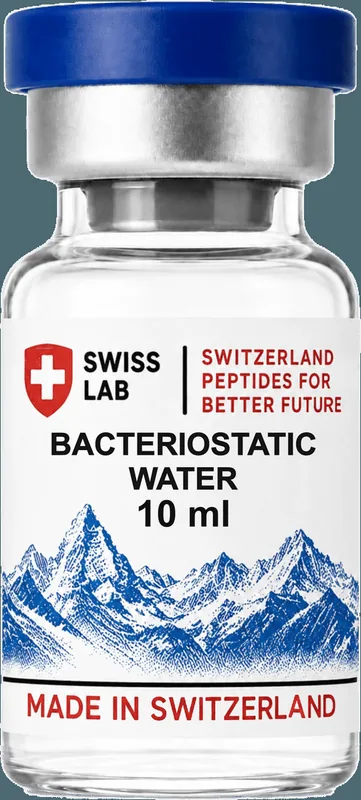
USP-compliant Sterile Bacteriostatic Water containing 0.9% (9 mg/mL) benzyl alcohol preservative in sealed borosilicate vials, engineered to inhibit bacterial proliferation across multi-aliquot peptide reconstitution workflows.
USP-compliant Sterile Bacteriostatic Water containing 0.9% (9 mg/mL) benzyl alcohol preservative in sealed borosilicate vials, engineered to inhibit bacterial proliferation across multi-aliquot peptide reconstitution workflows.
Analytical release verification for current Bacteriostatic Water (10 ml) inventory
| Batch Lot # | Release Date | Analytical Method | Purity Spec | Endotoxin (LAL) | Moisture |
|---|---|---|---|---|---|
| SL-2026-109 | 2026-10-28 | USP Sterility & LAL Endotoxin (<0.25 EU/mL) | Pass (USP <71>/<85>) | <0.25 EU/mL | Aqueous |
Ready-to-use sterile liquid diluent (USP Type I glass vial)
Store upright at controlled room temperature (15°C–25°C). Do NOT freeze liquid vials. Discard 28 days after initial septum puncture.
Bacteriostatic Water is sterile-filtered through a 0.22 µm membrane into USP Type I borosilicate glass vials and evaluated under USP <71> sterility and USP <85> LAL endotoxin (<0.25 EU/mL) benchmarks for multi-entry laboratory diluent reliability.
Freezing aqueous sterile diluents inside sealed borosilicate glass vials causes volumetric ice expansion that can fracture glass walls or deform elastomeric septa, compromising sterility. Keep liquid vials upright at controlled ambient temperature.
Bacteriostatic Water is formulated specifically for multi-entry sterile diluent for lyophilized peptide reconstitution. Always verify target peptide isoelectric point (pI) and hydrophobicity before selecting neutral vs. mildly acidic co-solvents.
Peer-reviewed mechanism summaries and analytical protocols
An analytical guide to laboratory reconstitution diluents. USP Bacteriostatic Water vs Sterile Water for Injection, antimicrobial mechanism of 0.9% Benzyl Alcohol, and pH stability.
A master laboratory protocol comparing peptide reconstitution solvents. Benzyl alcohol preservative dynamics, sodium chloride ionic strength effects on deamidation, and storage half-life data.
A practical guide for researchers. How to analyze HPLC chromatograms, verify retention time, interpret mass spec m/z peaks, evaluate counterion salt ratios, and spot fraudulent documents.
0 items selected • Min. order €220
Your cart is empty
Browse our catalog of research peptides and reagents (minimum order €220).